

The Scalp Standard: How Antipodes brought its skin logic to hair, and what it changes
There is a period, usually around week three of a new hair protocol, when something shifts that cannot be explained by the product alone. The scalp stops compensating. Oiliness levels out. Strands fall differently - not sleeker necessarily, but quieter, less reactive. What changed was not the surface. What changed was the ecosystem underneath it. Scalp health has been one of beauty's more awkward category expansions. The dermatologists arrived first, with their talk of pH balance and sebum regulation and the transepidermal dynamics of follicular tissue. The mainstream followed with scalp serums and exfoliants in attractive bottles, some rigorous, others decorative. Somewhere in between, a more fundamental question got lost: what if we stopped treating the scalp as the problem - the oily scalp, the flaky scalp, the itchy scalp - and started treating it as the context from which hair either thrives or doesn't?
Antipodes has spent more than 20 years working from that kind of thinking, applied to skin. Founded in Wellington by Elizabeth Barbalich, whose background spans both natural science and naturopathy, the brand built its identity around what it calls Scientific Green Beauty: the idea that high-performance results and botanical integrity are not in opposition, but require each other. Mānuka honey, harakeke flax, kawakawa, mamaku black fern: indigenous New Zealand botanicals proven not just for sensorial appeal but for measurable biological activity. Every formula undergoes consumer trials. Every claim is documented. That same methodology, applied to hair, produced something the brand had not originally intended to launch publicly. Antipodes had been supplying haircare formulas to luxury hotels for years, Wellington to London, and the requests kept arriving. After a multi-year development cycle, the answer became three silicone-free, SLS-free, paraben-free protocols and one universal intensive treatment. The haircare range arrived globally in early 2026, trialled by more than 600 participants across a range of hair types before a single bottle shipped at retail.
If this article resonated, come inside the Future of Skincare newsletter on Substack. Beauty Signals is the deeper layer within it, weekly patterns where skincare meets culture, for skin intellectuals, beauty anthropologists, and the cosmetics curious. Read the opening free, full access at latte with me level.
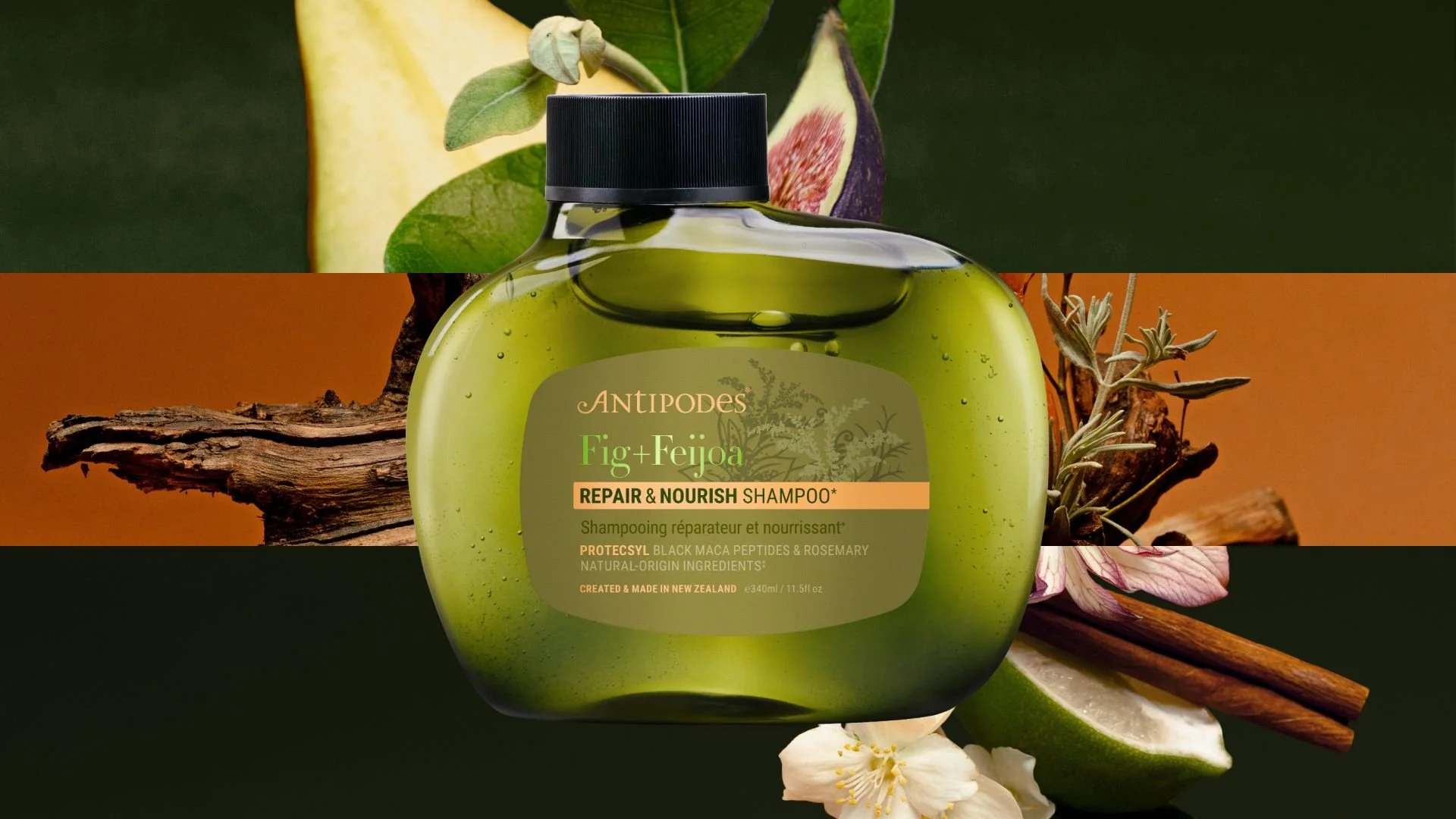
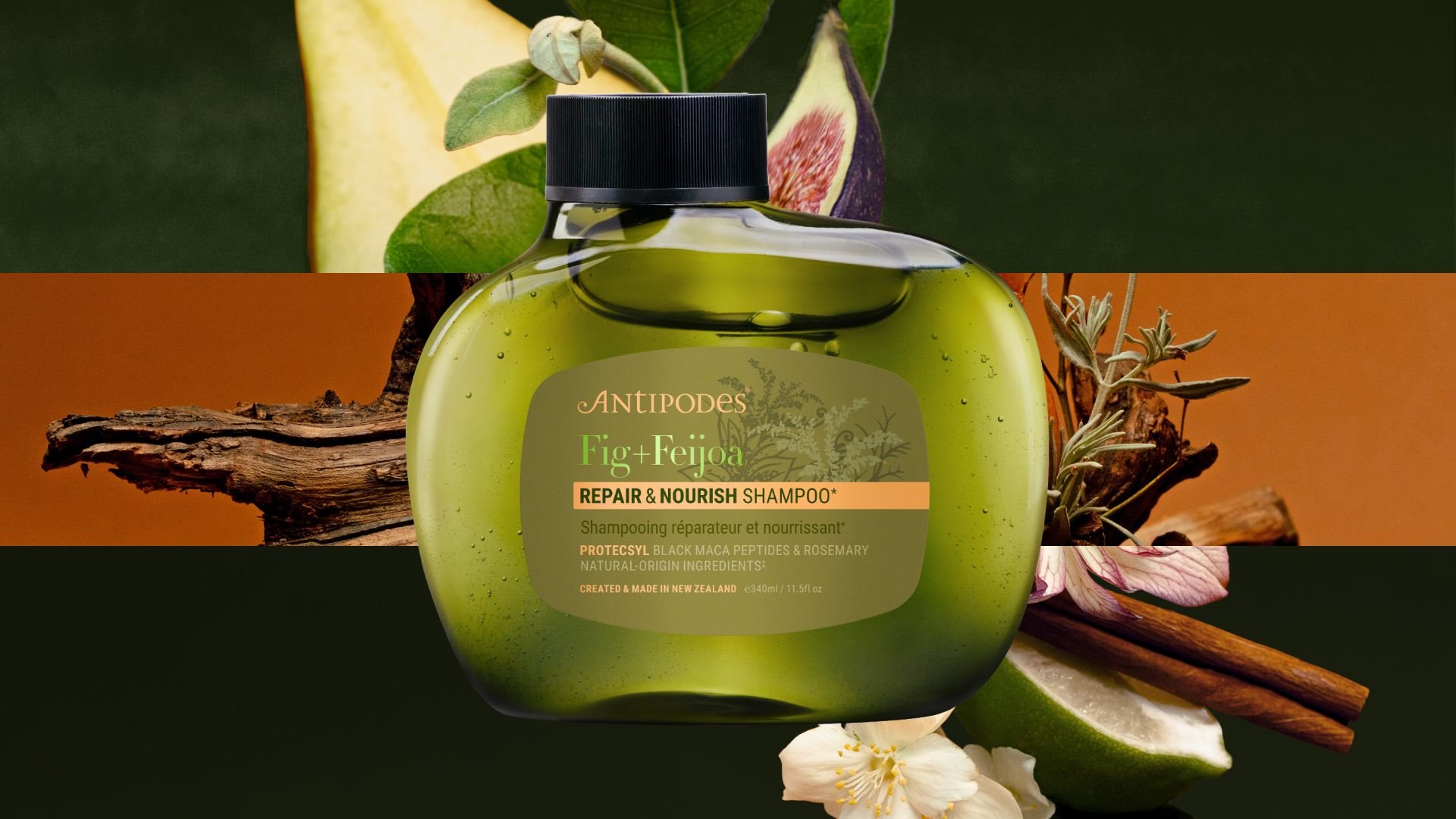
The collection organizes itself by concern rather than hair type - a small distinction that matters. Fig + Feijoa Repair & Nourish addresses dry, damaged, or colour-treated strands with PROTECSYL, a peptide complex derived from Peruvian black maca that reinforces keratin proteins and defends against oxidative stress. The scent reads like an orchard before the heat arrives - fig, feijoa leaf, pear, white cedarwood - botanical but not sweet. In trials across 155 participants, 90% reported visibly less frizz; 85% found hair looked healthier. The shampoo builds a clean lather without stripping. The conditioner delivers weight without coating.
Peach Freesia Smooth & Hydrate takes the silicone question seriously. Instead of synthetic polymers that produce the sensation of smoothness without altering the hair's actual condition, Antipodes uses Hydresia™ - oleosomes extracted from safflower that gradually release vitamin E and essential fatty acids along each strand. The mechanism matters: this is slow-release hydration, not surface-level slip. For frizzy or dehydrated hair, the difference is felt from the second wash, not just the first. The scent - freesia, Japanese white peach, vanilla pod, a suggestion of star anise - is warmer, summery, restrained. Trial data: 90% agreed scalp felt calm and soothed; 87% felt more hydrated.
Mānuka + Orange Volume & Shine targets fine, flat, or dull hair through Xylishine™, a protein-rich seaweed extract sourced from Atlantic shores that restores cuticle integrity for reflective, lightweight shine. This is not the kind of shine that comes from a laminating coat. It is closer to the light that bounces off hair that has been properly nourished from the inside. Mānuka honey, included across the range, draws moisture to the scalp and comforts tissue that has been stressed by hard water or product accumulation. Rosemary oil supports scalp circulation. Harakeke flax gel smooths the surface without weighing it down.
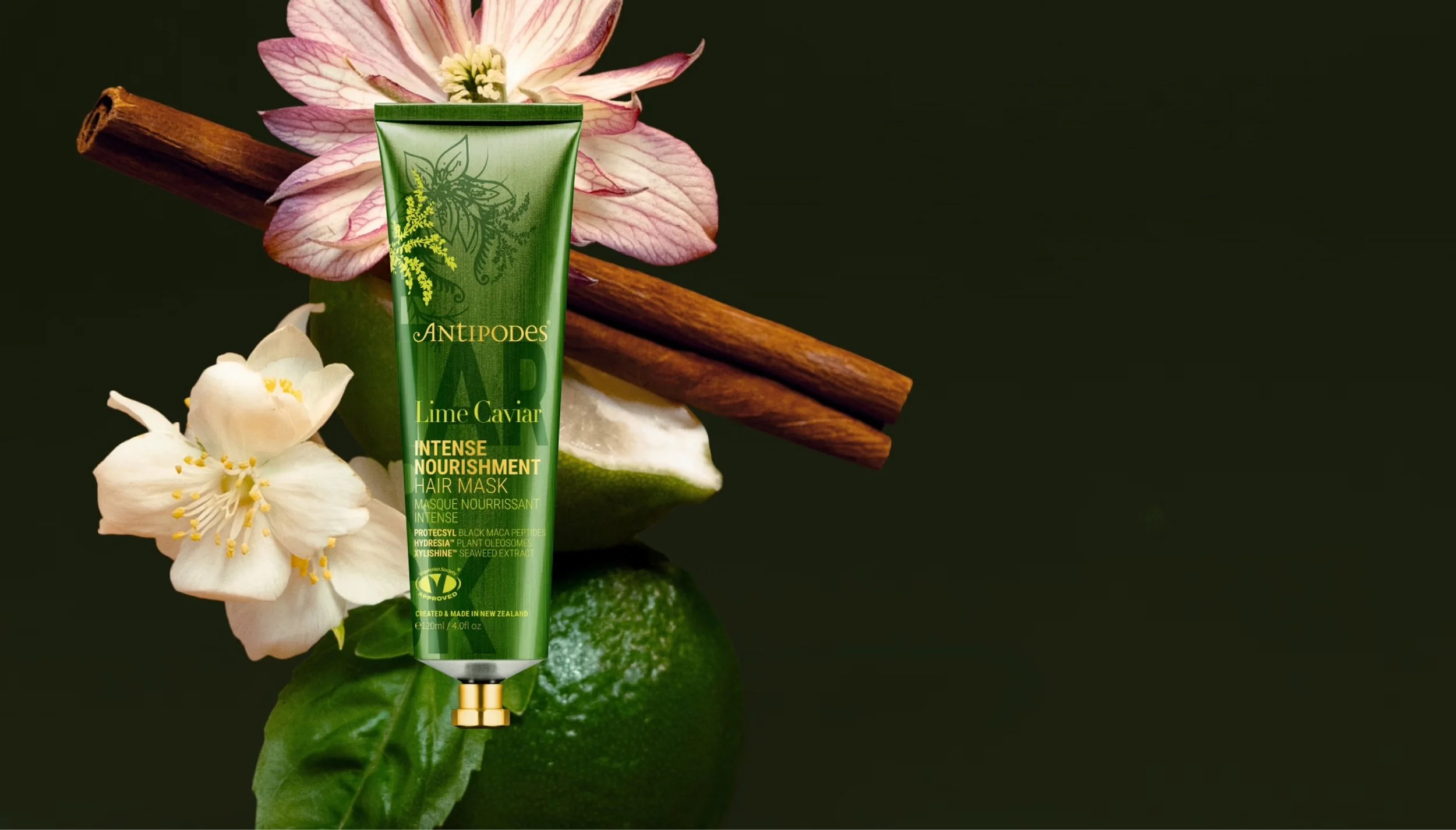
The Lime Caviar Intense Nourishment Hair Mask functions as the weekly reset. All three bioactives - PROTECSYL, Hydresia™, Xylishine™ - are present, alongside lime caviar AHAs that gently exfoliate the scalp surface, clearing the accumulation that disrupts follicular environment over time. It is curl-friendly by design; Antipodes ran a dedicated trial with participants with curly and coily hair, and many reported the mask performs as a leave-in cream for tighter patterns.
The scalp-as-skin conversation gained real traction somewhere between 2022 and 2024, as barrier culture moved from face to body and eventually upward. What had once been the domain of trichology clinics became a framework that prestige consumers were ready for. The timing aligned with a broader fatigue toward silicone-dependent haircare: the sensation of slip without the underlying change, the coat of smoothness that must be stripped each week before it can be reapplied.
Antipodes was not trying to catch a trend. The hotel requests had been accumulating for years before the brand committed to a consumer launch. That lag - the multi-year development cycle, the 600-participant trial, the decision to launch in limited batches - signals something about the brand's relationship with its own category. There is no rush to be first. There is a deliberate pace that matches, in spirit, the way these formulas ask to be used.
To integrate a scalp-first protocol into a hair ritual is to make a specific kind of decision: that the strand is worth caring for at the level of the follicle, not just the surface. It is a longer view. The results compound - 77% of Repair & Nourish participants agreed hair felt stronger and healthier after two weeks, a number that tends to grow rather than plateau as the scalp's microbiome stabilizes. The protocol asks for consistency over intensity.
There is something in the Antipodes haircare range that feels continuous with the brand's original premise in skincare: that the body's biology is intelligent, and that the most productive thing a formula can do is work with it rather than override it. The scalp knows how to produce the right amount of sebum. It knows how to support follicular growth. It knows when it has been disrupted and signals accordingly. What these formulas offer is not correction. It is the conditions under which the scalp can return to its own signal - quieter, more balanced, more itself.
