

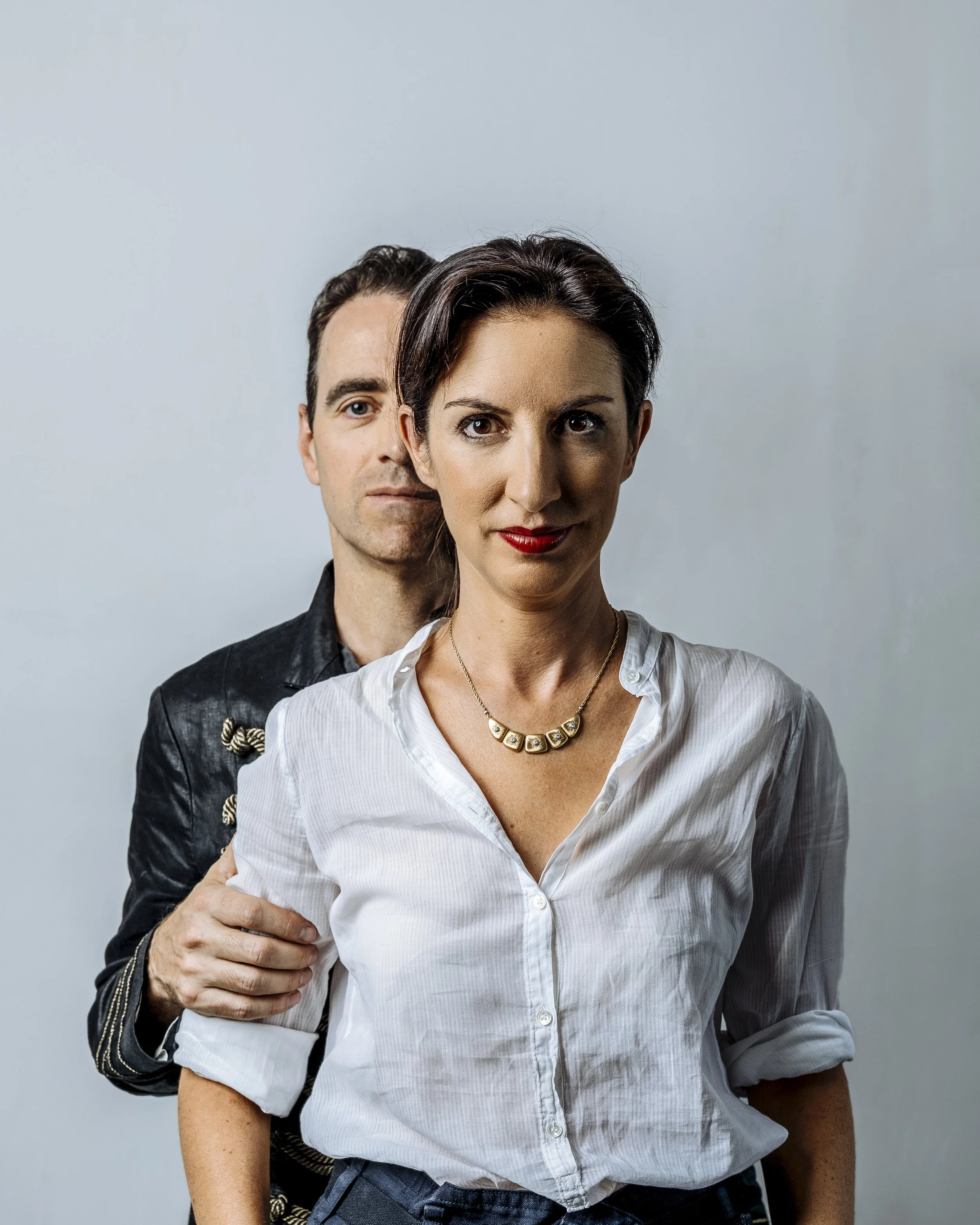
Clara and John Molloy, founders of Memo Paris.
At 24 rue Cambon, Memo Paris has a map engraved into the stone of its boutique’s central table. It is the house’s own Carte de Tendre, inspired by the imaginary geography of love published in Madeleine de Scudéry’s Clélie in 1654. In that literary landscape, feelings became places one could travel through. Clara Molloy and John Molloy have found a particularly fitting home for the idea in perfumery, where a few drops can make a distant place feel intimately familiar.
Since founding Memo Paris in 2007, the couple have built a collection whose names invite the imagination to move: Lalibela, Inlé, Marfa, Madurai. A fragrance can carry something of the books we read, the landscapes we remember, the places we have yet to see. It gives these impressions a physical presence in our lives. The pleasure is partly in recognizing something, partly in discovering what we had never thought to look for.
Memo gives that imagination several forms. For Odéon, Jean Jullien painted a pink Parisian sky and drew a flâneur; for Darling Point, Thomas Lélu brings his language to the bottle and to a surfboard made with the house. Humor and play have a place in this literary imagination.
I wanted to speak with Clara Molloy and John Molloy about the life behind this world: how they create together, how they recognize a fragrance worth pursuing, and how their curiosity finds its way into the things they use every day. The conversation returns to a question that interests me across beauty: how does a personal sensibility become something other people can make their own? At Memo Paris, the answer begins with two people’s way of seeing the world, and continues every time someone puts on their perfume.
Read the conversation below.
If this article resonated, come inside the Future of Skincare newsletter on Substack. Beauty Signals is the deeper layer within it, weekly patterns where skincare meets culture, for skin intellectuals, beauty anthropologists, and the cosmetics curious. Read the opening free, full access at latte with me level.
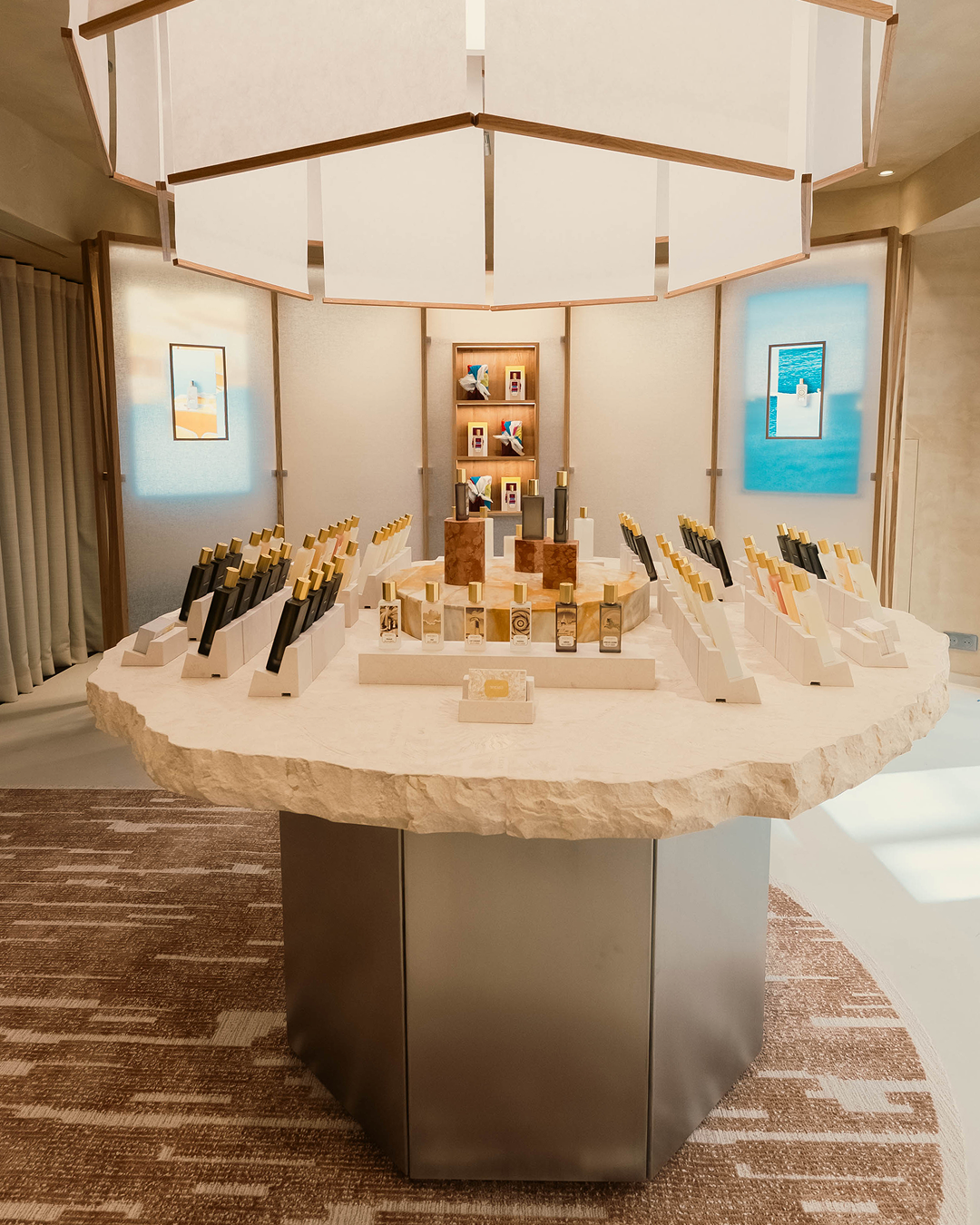
The orientation table at Memo Paris, 24 rue Cambon. Boutique designed with Ciguë.
Clara, before Memo there was 22 Perfumers: A Creative Process, the book where you interviewed the greatest noses of your time. Twenty years on, what did those conversations teach you that still shapes the way you brief a perfumer today?
This book was a turning point; the encounters it led to guided me towards two things: listening to my own sensitivity and freedom, and heeding my intuitions whilst breaking free. Many of the perfumers I’ve been lucky enough to meet, who remained in the shadows at that time, have had the audacity to create, to combine ideas, to imagine worlds, and that is still what drives me with Memo Paris. These perfumers still inspire me today: Alienor Massenet and Sophie Labbé, to name but a few, enrich my vision of perfume every day.
John, your path runs from weekends at Brown Thomas to Kenzo, LVMH and L'Oréal Luxe before you joined Memo full time. What did big luxury teach you that you deliberately chose not to bring into Memo?
Time-consuming patterns. Compromise.
You have built Memo as a couple for nearly two decades. Can you recall a decision where your different instincts led to something neither of you would have arrived at alone?
That’s pretty much our whole story! Achieving together what we couldn’t have done alone. When it comes to fragrances, Madurai is a good example. In 2021, this fragrance wasn’t planned at all, but we fell in love with the scent and completely shook up our priorities for the year. In the end, the creative process and the commercial schedule fell into place. And Madurai has become an iconic.
You founded Memo in 2007, when niche perfumery barely existed as a category. What did you see then that the rest of the industry only understood later?
Above all, we believed in our own vision, in a fairly direct and intuitive way, without paying too much attention to what was going on around us; otherwise, the desire to create turns into a desire to do better than others – or at least as well – which undermines any project.
Memo comes from memory, and research keeps confirming that smell is our most direct route to it. How has your own relationship with memory, personal and collective, evolved as the house has grown?
We like to think that scents give us news about ourselves and nurture our individuality. They rekindle visions and emotions when they are linked to past moments in life, but creating new fragrances is yet another process – one that is utterly magical and joyful – because they evoke new images and feelings: on our own skin, on the skin of friends, they enrich our emotional vocabulary. Memory is not static; it is constantly exploring, an archive that evolves with us.
Clara, you have said that a landscape has a face, a sound, a respiration. When a place becomes a perfume, what is the moment you know the translation is right?
I’m thinking of this quote from the great French film director Agnès Varda: ‘If you were to open people up, you’d find landscapes.’ A fragrance is complete when the olfactory landscape we have in mind harmonises with the skin, that other landscape. The question of when this alchemy occurs is linked to the creative process, so it remains something of a mystery. The perfumer, my team and I can sense when a fragrance has found its true expression. There’s just one constant: it has to take us by surprise, like a chance encounter.
Darling Point sets course for Sydney. Why Sydney, why now, and what did the bay give you that no other destination could?
I am very drawn to the sound of words, and sometimes the names of destinations catch my attention and are enough to make me want to travel and settle somewhere. That was the case with Darling Point. ‘Darling’, suggesting a sense of attachment, followed by ‘Point’, like an end in itself. Gentleness and its conclusion. I loved the combination of these two words, and their Australian essence also allowed us to explore a part of the continent we’d never visited before. In a neighbourhood of Sydney that combines the sea, music, surfing, architecture… a real gem!
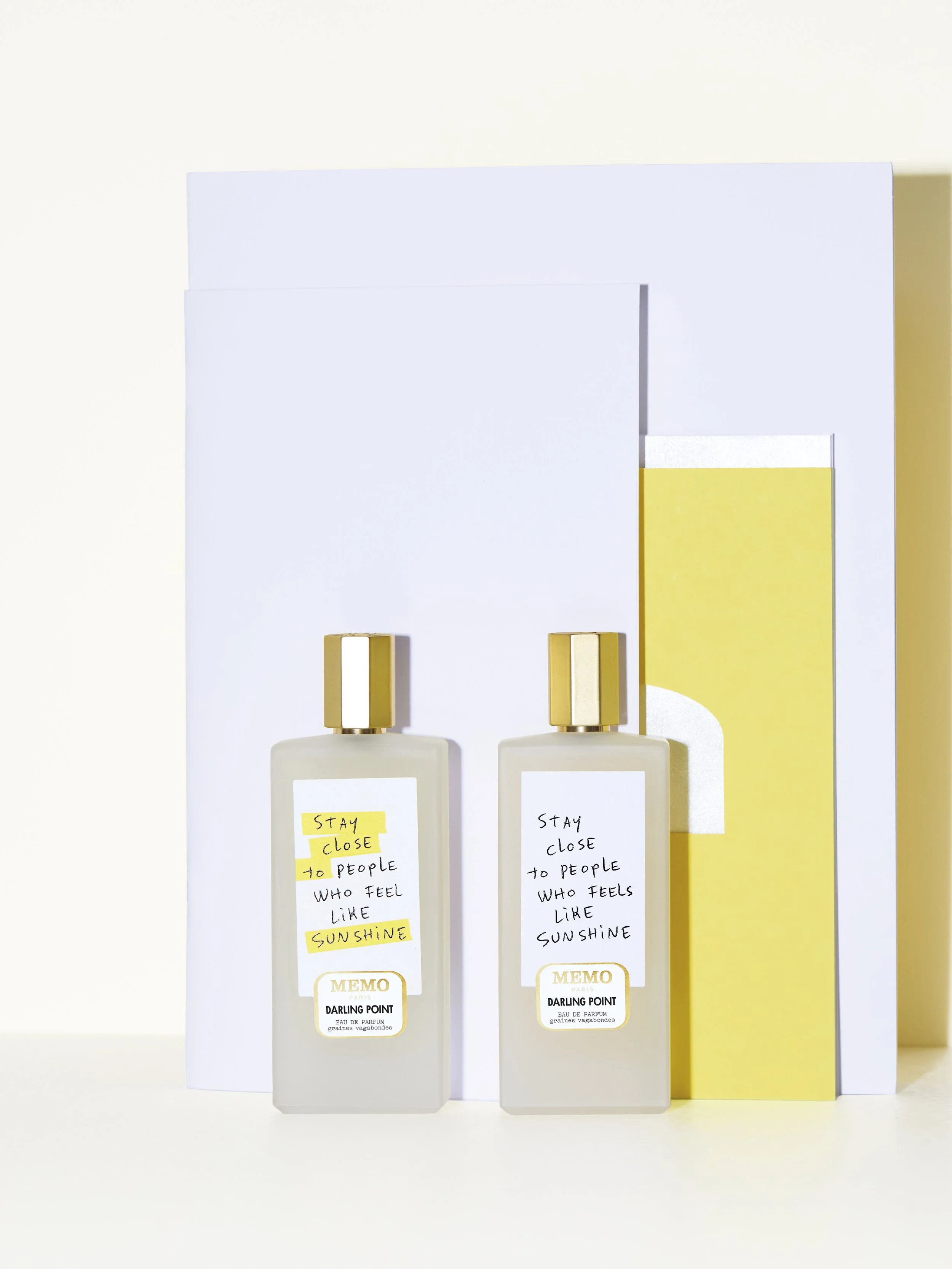
Darling Point, Memo Paris with Thomas Lélu.
The composition is built around a perfectly sweet pear, lifted by orange blossom and rose absolute, resting on praline and cashmere wood. How do you keep a gourmand this generous from tipping into sweetness?
It is the talent of perfumer Alienor Massenet that I wish to pay tribute to here. We have been working together since the early days of Memo Paris; she created one of our first fragrances, Lalibela, as well as our first leather scent, Irish Leather. We both instinctively feel how to bring a fragrance to life so that it finds its place within the Memo Paris world: the indulgent quality of the pear becomes a delicate balancing act... Finding expressive power and delightful connections in contrasts is what brings Alienor and me together.
The Darling Point Essences Set lets the wearer emphasize individual notes within the fragrance. What interested you in giving people that freedom, and which combination would each of you suggest trying first?
Freedom is exactly the right word; that is what we are seeking in a fragrance: for everyone to feel a surge of freedom when wearing it. In creating this set, which allows the main notes of a fragrance to stand out on their own, our aim was to enable each person to accentuate each of these facets as they wish. It’s about preserving the personality of a composition whilst playing with its notes, and creating a new journey within the fragrance itself. I’d go for saffron and orange blossom, or cinnamon and rose, or pear and praline. In short, combinations that bring out further contrasts.
Thomas Lélu signs the bottle. His world of viral maxims is pop and immediate; yours is slow, literary, poetic. What did you want these two grammars to say to each other?
Thomas’s prose precisely challenges our own language and makes us want a bit more cheekiness too! It’s these encounters with artists who have strong visions that prevent us from getting too complacent and keep us on our toes. I also really like the fact that his words appear on a surfboard we co-produced: stay alert on the wave – the mighty sea knows best. That’s a bit like how we make perfume, too.
From the Art Land collection to Jean Jullien's illustrated Odéon, the flacon has always been a canvas at Memo. Why is it essential to you that a perfume bottle remains a place for artists?
To us, the surface of the bottle is like a frame, and bringing it to life with a drawing or a painting is a way to lend the composition an extra touch of soul. We love perfume, art and words in equal measure, and it’s a real privilege to invite artists to express their vision of a fragrance through their chosen medium. This takes the heart and mind even further; the destination becomes a place of dreams and imagination, and so does the fragrance; art and life come together – what more could one ask for?
Aliénor Massenet has composed most of your fragrances since Lalibela. What does a nearly twenty-year dialogue between a creative director and a nose make possible that a new collaboration cannot?
Our close working relationship is indeed precious; it allows us to constantly refresh our perspective on new fragrances through mutual understanding, but we also welcome other perfumers with great enthusiasm. Take Gaël Montero, for example, who, with Madurai, gave us his take on jasmine, which completely won us over. And Dalia Izem, too, for our first collaboration coming soon... I believe it is essential not to close ourselves off to new perspectives and new encounters; this enables us to move forward and to venture into new territory, which is, after all, what defines us!
With Hermetica, you patented alcohol-free fragrance years before clean beauty became an industry standard. Where is the real frontier of fragrance formulation today?
The sincerity of the approach. That is the only course of action to take.
Your renewed rue Cambon boutique includes a Dark Room for discovering fragrance. What did you want people to notice there, and what have their reactions taught you so far?
The whole boutique, designed in collaboration with the Ciguë architectural agency, is conceived around an initial journey from day to night, which evokes time, movement and cycles. This Night Room slows down time, allowing one to reflect, as it were, and to take in a scent more fully, as the senses are heightened there and everything feels more vivid. The bottles are arranged on the wall, like gateways to a dream. And this idea of pausing for a moment to ask yourself: would I prefer to smell vetiver or tuberose? I would so love for these kinds of questions and choices to become the keys to a more peaceful way of life!
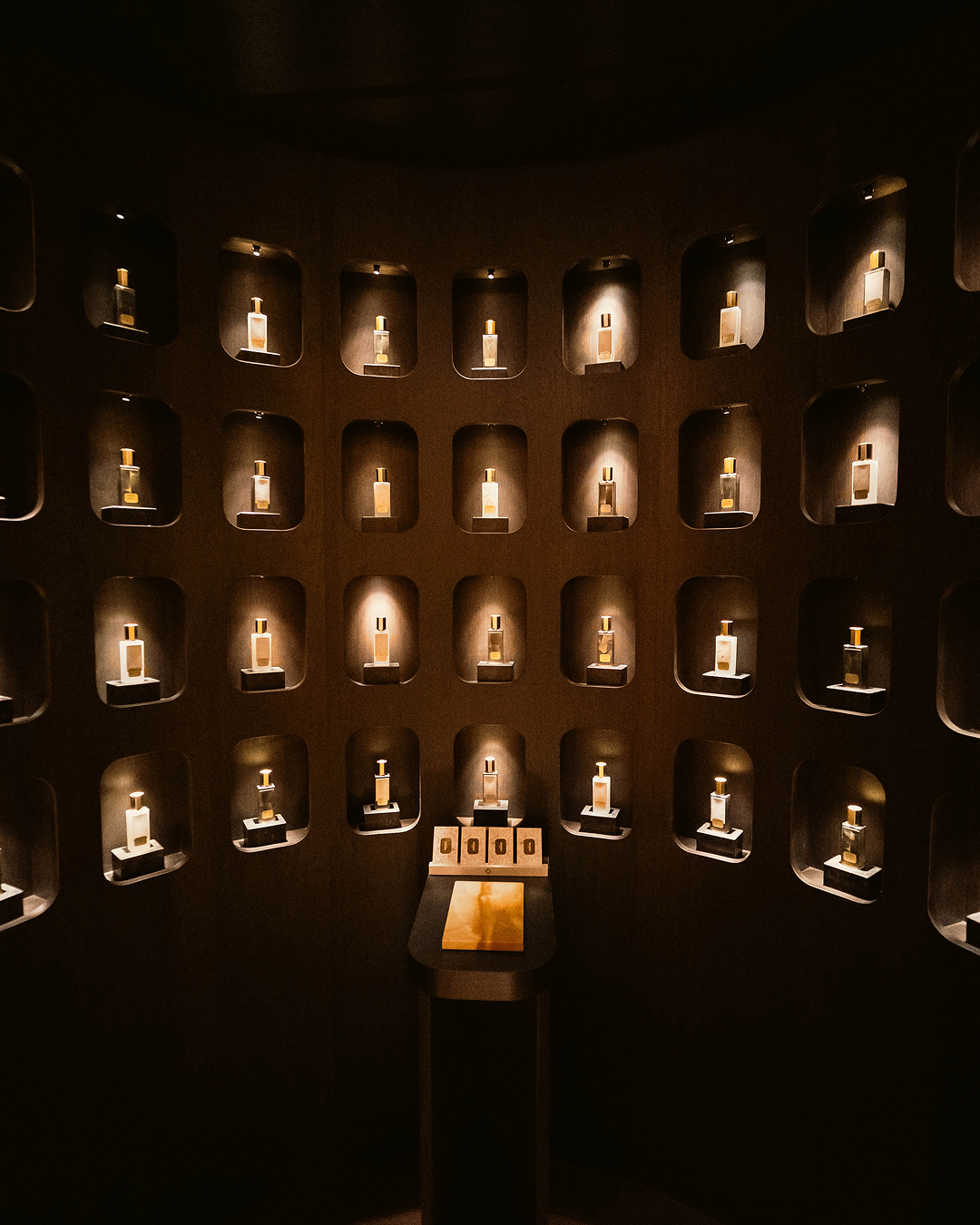
Fragrance discovery at the Memo Paris boutique, 24 rue Cambon.
Niche perfumery has become the most crowded territory in beauty. What does staying independent and founder-led allow you to refuse?
To make choices that wouldn’t reflect who we are, to need to please and charm at all costs, to lower our quality standards, to create fragrances based on consumer tests, to lose our way…
What do your own skincare and wellbeing routines look like on an ordinary morning?
Which products or habits stay with you when you travel? We actually sometimes share skincare. All day all year by Sisley is our morning base. For me, Clara, I put before that a spray of fresh water “Eau Thermale” by Avène. I feel it cleans my skin from the night... and it also wakes me up. In the summer we add their index 50 solar cream which is fantastic : it is like a super cream, anti-aging, but it also protects you from the sun. For John there is a little of beard grooming with a Hair ritual product by Sisley also. I don't know if the lip sleeping mask from Laneige works, but I love its name. Sometimes this is enough... When I travel I put the Nuxe “Crème fraîche de beauté” which is super thick. It can do many things : remove male up, act like a mask, hydrate the skin... The “Baume efficace” by Sisley is also super-efficient as its name says. We bring the Marvis mouthwash strong mint, to be ready for any kind of food encounter abroad. Of course we do not leave the house without our travel perfume set : Madurai for me and Odéon for John.
To close, our usual discovery question: which three beauty or wellbeing products or brands would each of you recommend beyond your own, and what keeps you coming back to them?
Every time I go out I put the Black Rose mask on before Make up. That is when I can find me because our teenagers keep stealing it from us. It solves any little skin problem and gives me a little lifting effect. Life changing. We also enjoy the Honey shampoo by Leonor Grey. The smell is amazing and it makes really soft shiny hair. We alternate with the Sisley shampoo. We love our soaps and body line : it feels incredible to have the perfume you love in different formats. I usually bring my soap and shampoo when I travel, in a nice pouch, even if I am always eager to discover new products. If I have travel to a place I don't really, I would bring a scented candle to change the atmosphere.
